

What's Happening in the Market
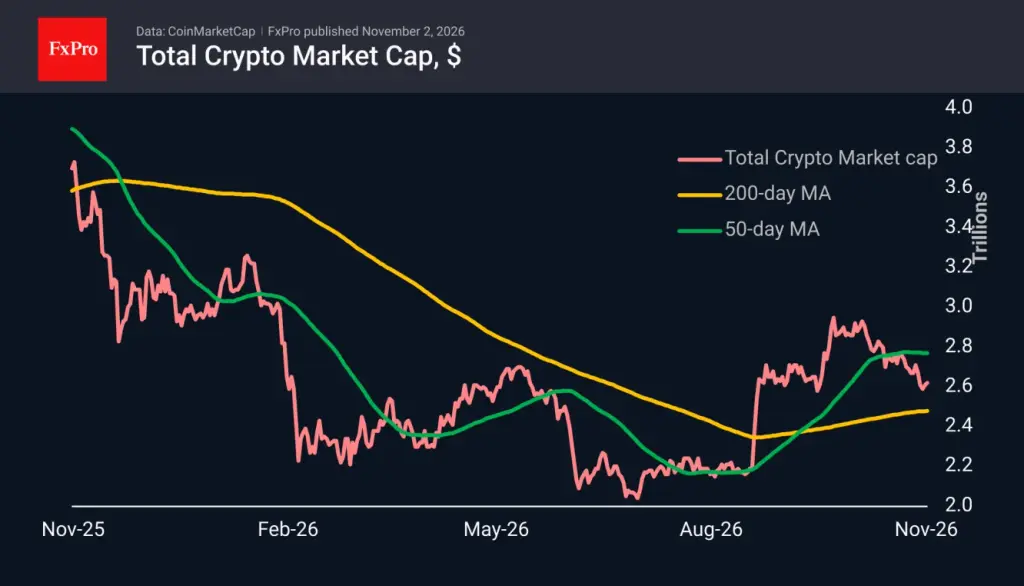
Since last Friday, the market has shown signs of growth: total market capitalization rose from $2.55 trillion to $2.62 trillion. This upturn is entirely understandable. Over the weekend, investors became more willing to take risks amid falling oil prices and a weaker dollar, as well as attempts by the stock market to recover. However, cryptocurrencies are still only trying to recoup their previous losses, as even Friday’s losses have not yet been fully recovered. Over the past 24 hours, Official Trump (+3.1%), Tron (+1.7%), and Ethereum (+1.1%) posted the best results. Meanwhile, Basic Attention Token (-7.1%), Near Protocol (-5.8%), and Theta Network (-3.9%) saw the biggest declines.
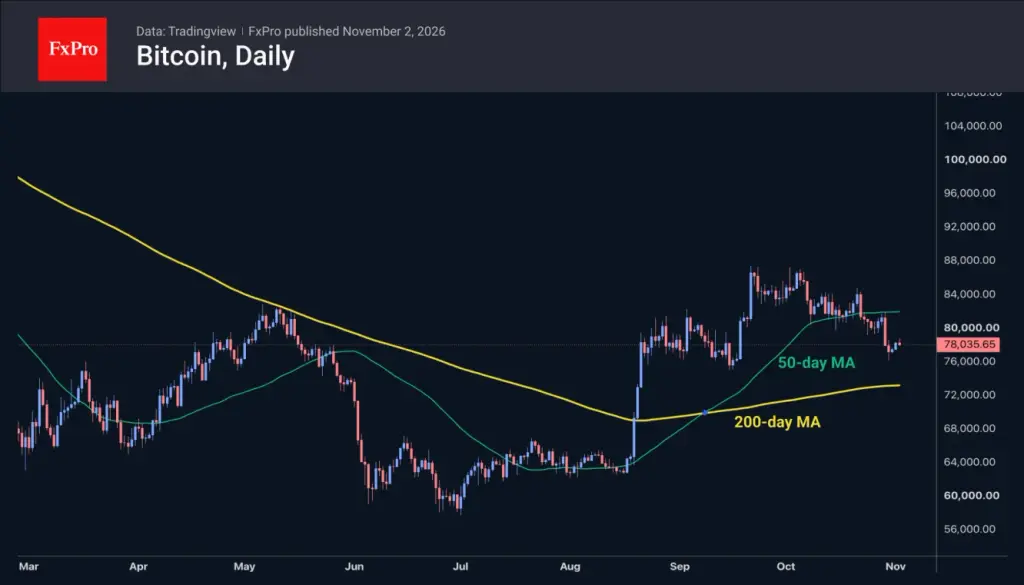
In October, Bitcoin lost 7.5% of its value, dropping to $77,400. This is the second consecutive time the market has bucked seasonal trends, as October is typically considered a profitable month. Following a quarter of growth, this decline was the sharpest for October since 2014. Historically, November is traditionally considered a favorable period for BTC: over the past 15 years, gains have been observed in nine instances. On average, the price rises by 24% and falls by 16.8%.
On Monday, ahead of the European session’s opening, BTC is trading around $78,000, as it failed to decisively break through the $79,000 level during the day. Bitcoin found support at levels close to those seen in mid-September, but technical indicators still favor sellers. On October 29, a sharp crash occurred as the price attempted to break through the 50-day moving average from below, and the asset has been in a downtrend for nearly a month now.
News and Context
According to SoSoValue, $202.6 million was withdrawn from U.S. spot Bitcoin ETFs over the past week. This means that outflows have returned after a period of inflows. In total, investors withdrew $515 million from U.S. Bitcoin ETFs in October.
The situation with Ethereum ETFs is no better: there has been a five-week streak of outflows, totaling $431.5 million last week. In October, a record $1.61 billion was withdrawn from U.S. Ethereum ETFs.

Experts at Standard Chartered believe that the situation with Binance could force traders to switch to decentralized exchanges (DEXs) and predict a further decline in cryptocurrency prices. The market will stabilize only once all the details of the hack and the fate of the frozen funds become clear.
OneKey speculates that BlackRock’s largest Bitcoin ETF, which manages 815,000 BTC, could become a target for North Korean hackers. It is worth noting that the fund’s main reserves are held on the Coinbase exchange in the U.S.
Analysts at Chainalysis, who monitor crypto transactions, reported a breach of their internal systems. As a result of the actions of an unknown individual, users’ names, email addresses, and other personal information may have been compromised.
Strategy reported a net profit of $19.53 billion for the third quarter. This represents a massive jump compared to the $2.79 billion recorded during the same period last year. This result was largely driven by unrealized gains from the revaluation of crypto assets, which totaled $20.91 billion.