
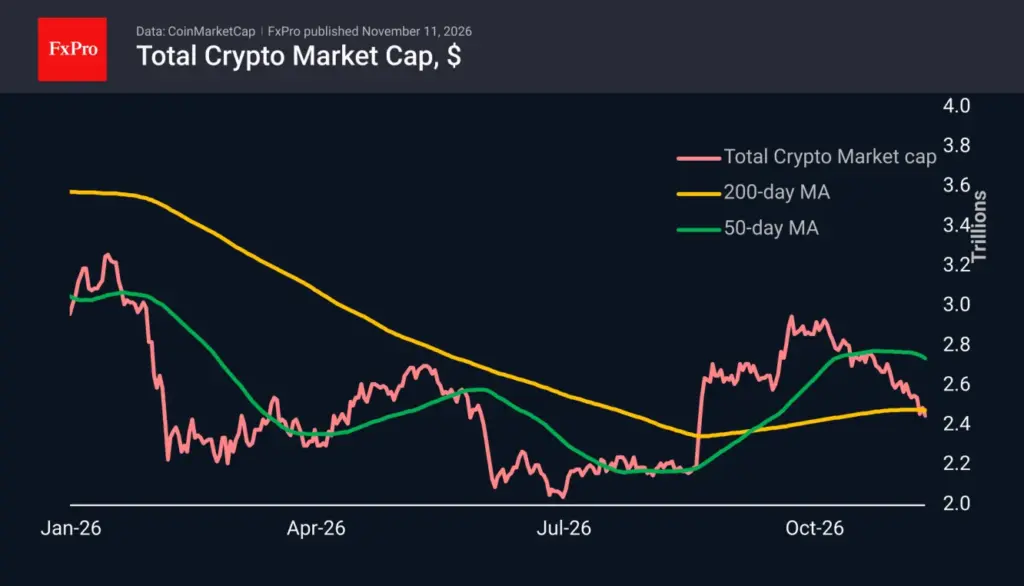
The total market capitalization of digital assets fell by more than 1.5%, dropping to $2.45 trillion. This is the lowest level since August. All eyes are now on Bitcoin: it is testing the strength of its 200-day moving average at $74K.
What’s driving this? First, the dollar is strengthening due to positive labor market reports and comments from Waller, who hasn’t ruled out a 50-basis-point rate hike by the Fed in December. Second, we’re seeing investors shift funds into the artificial intelligence sector in anticipation of Anthropic’s IPO. The key target right now is to stay above the 200-day MA. If the price drops below that level, the decline could become much more severe.
Market Overview
Over the past 24 hours, the crypto industry has lost more than 1.5% of its value, reaching the $2.45 trillion mark, which has effectively brought us back to August lows. While altcoins were simply lagging behind the stock market on Monday, they began to weaken significantly on Tuesday. There are several reasons for this. Most likely, interest in artificial intelligence ahead of Anthropic’s IPO is once again drawing capital out of the cryptocurrency market, as it did in May and June. In addition, CPI inflation came in higher than expected, and the stability of the U.S. economy, coupled with Waller’s remarks, has driven the dollar higher. This sets the stage for a Fed rate hike in December. This situation is favorable for stocks but has a negative impact on cryptocurrencies and gold. Among altcoins, Internet Computer (+4.8%), Avalanche (+4.5%), and Cosmos (+2.6%) are performing slightly better than others today. Meanwhile, Uniswap (-7%), Dash (-4.3%), and Basic Attention Token (-2.8%) have dropped significantly. Overall, the situation isn’t very encouraging right now: for every asset that’s rising, there are six that are falling.
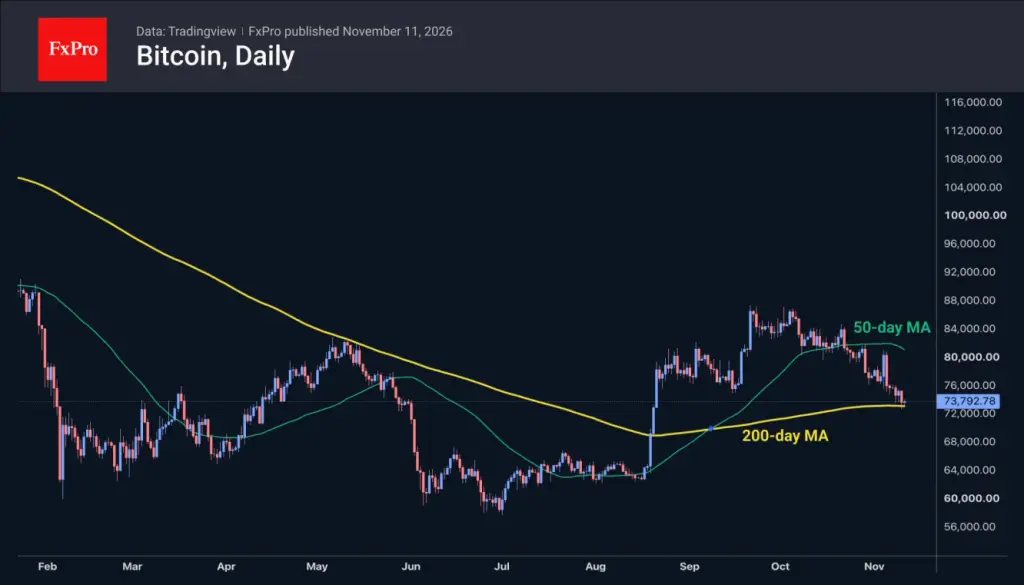
Bitcoin has fallen below $74K and is now very close to its 200-day moving average. A slight rise on Monday quickly gave way to a sell-off, causing prices to hit their lowest levels since August. While statements from Fed and Treasury officials pushed the price higher over the summer, fundamental factors are now working against buyers, who fear a tightening of anti-inflationary policies. From a technical standpoint, we’ve now reached a critical juncture: if we break below the 200-day MA, a deep sell-off could begin. And simply holding these levels won’t be enough—a strong upward impulse directly from the support zone is needed to reverse the trend.
News Background
Major players are increasingly transferring Bitcoin to exchanges, which is putting pressure on the price. Although leverage levels have declined somewhat, they remain high. Experts at XWIN Japan believe that in order to halt the decline and begin rising, Bitcoin needs to bring buyers back to the spot market.
Analyst Quentin François noted that Bitcoin has entered a zone on the MVRV indicator that previously signaled major corrections in 2020 and 2023.

Mark Harvey added that BTC has broken through the lower boundary of its exponential model, which defines the long-term growth corridor. Previously, such breakdowns ended very painfully, as was the case during the FTX collapse or during the pandemic.
Benjamin Cowen of Into the Cryptoverse believes that the correction could drag on for several weeks, and we may not see the market’s lowest levels until December.
According to Lookonchain, since the beginning of 2026, public companies have sold approximately 108,247 BTC worth $8.08 billion. This was primarily driven by MARA and Riot Platforms.
Meanwhile, PNC Bank, in partnership with Coinbase, is testing the ability to accept USDC payments via the Ethereum network. This is expected to simplify international payments for businesses.
And the New York Stock Exchange (NYSE) plans to use the Avalanche network for clearing and settlement on its new platform for tokenized securities. To do this, they will launch a separate blockchain with restricted access.
And finally: Senator Elizabeth Warren intends to tighten oversight of prediction markets and crypto projects linked to the Trump family as soon as she takes the helm of the Senate Banking Committee in January.