

According to The Block, Jeff Yan presented an analysis of exactly how blockchain is useful for market operations.
According to Yang, the main advantages of blockchain-based trading are transparency and the ability to manage one’s own assets independently. He also noted that 24/7 trading is no longer unique to cryptocurrencies, as traditional financial institutions are also gradually extending their operating hours.
However, the key difference between decentralized systems lies in self-custody. This means that users manage their own funds and are less dependent on intermediaries. This is critically important if risks arise from custodians or counterparties. Moreover, blockchain allows users to verify every transaction and how the system itself operates. Yan is convinced that infrastructure managed by private companies simply cannot provide this level of control.
At the same time, he once again emphasized the importance of round-the-clock operation. This is particularly evident with assets that lose liquidity when traditional exchanges close. These include stocks, commodities, and instruments for valuing private companies prior to their IPOs.
On Hyperliquid itself, interest in these segments is growing very rapidly. While trading volume in perpetual contracts via the HIP-3 protocol accounted for just 2% at the start of the year, it had jumped to nearly 50% by July. The most popular instruments right now are the Nasdaq-100, Tesla, and Nvidia. In June, open interest in markets created by third-party developers via HIP-3 reached approximately $4 billion. This included indices, commodities, stocks, and instruments for valuing the private sector.
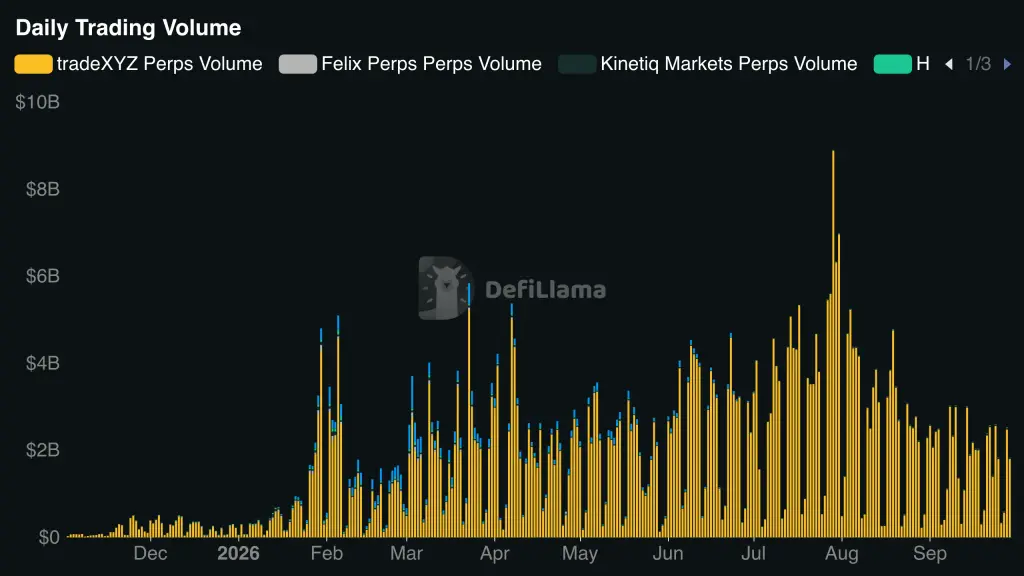
Yang also highlighted the potential of markets for private companies. He noted that a significant portion of a company’s value is created even before it goes public, but accessing such assets is currently difficult. According to his projections, the emergence of global pricing mechanisms will enable the valuation of companies in their early stages and make this market accessible worldwide. Contracts tied to the valuations of SpaceX and OpenAI are already available on Hyperliquid.
Incidentally, in July, real-world assets (RWAs) accounted for more than half of Hyperliquid’s weekly trading volume for the first time, reaching $25.1 billion out of a total of $48.2 billion.