

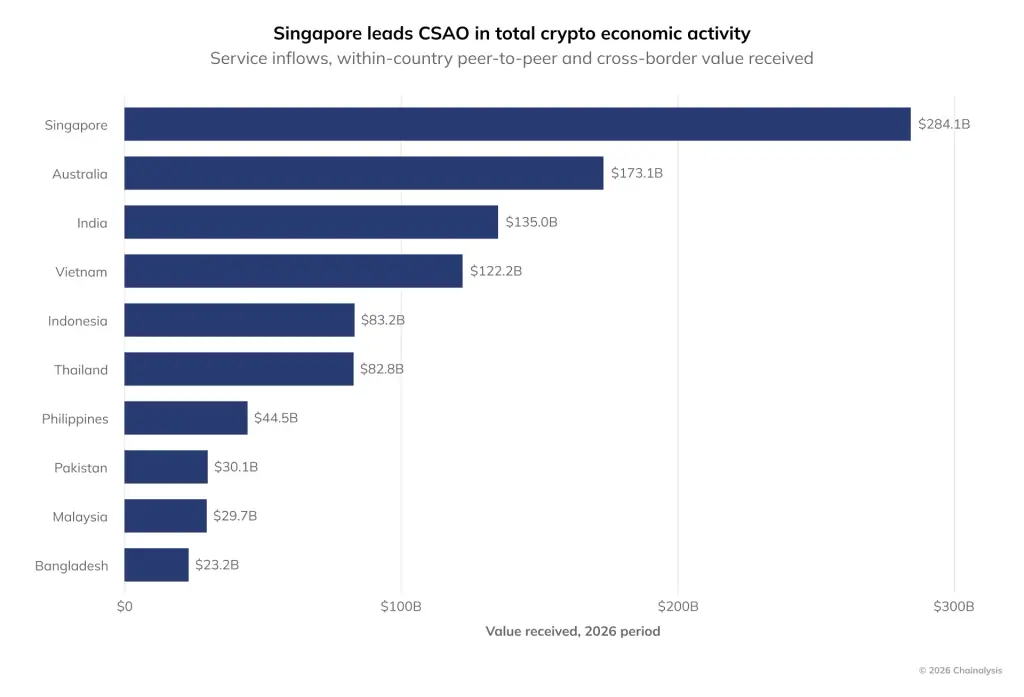
While the entire region is experiencing a downturn, there is a veritable institutional boom here totaling $284 billion.
According to the latest Chainalysis report, over the past twelve months (as of June 2026), the volume of crypto transactions in Singapore has grown by 55.4%. This is particularly striking when viewed against the broader picture in Central and Southeast Asia, Oceania, and neighboring countries, where total on-chain turnover has declined by 6.8%. The industry is currently undergoing a major transformation: speculative trading is giving way to corporate treasuries, asset tokenization, and a robust settlement infrastructure.
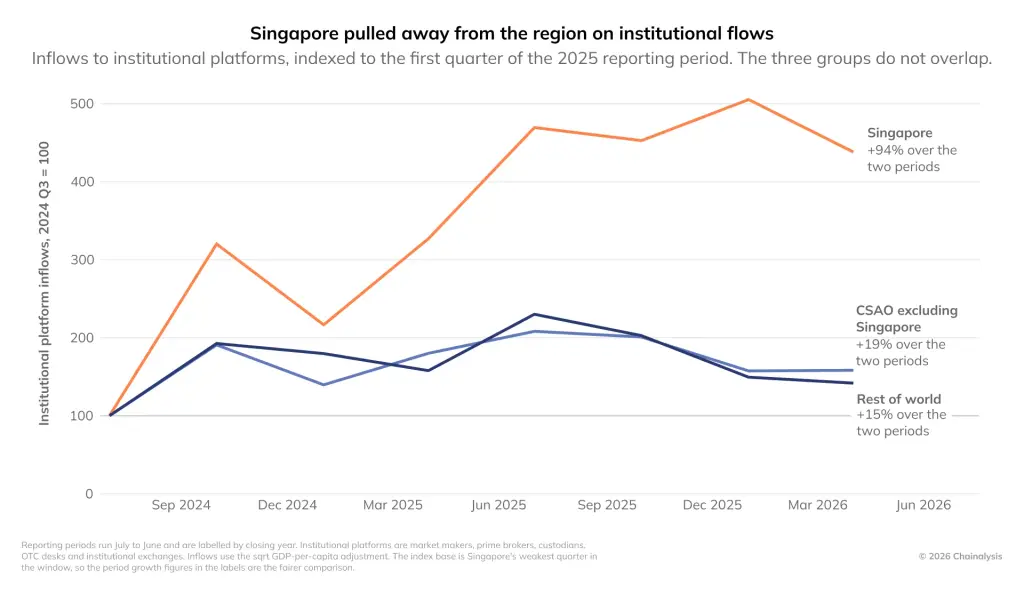
Singapore’s Institutional Leap: Moving Away from Personal Wallets
Professional players and licensed platforms have become the main drivers of growth. Here’s what’s happening in the market:
Growth of the over-the-counter (OTC) segment: The volume of transactions through brokers, market makers, and OTC desks soared by 94%, reaching $60 billion.
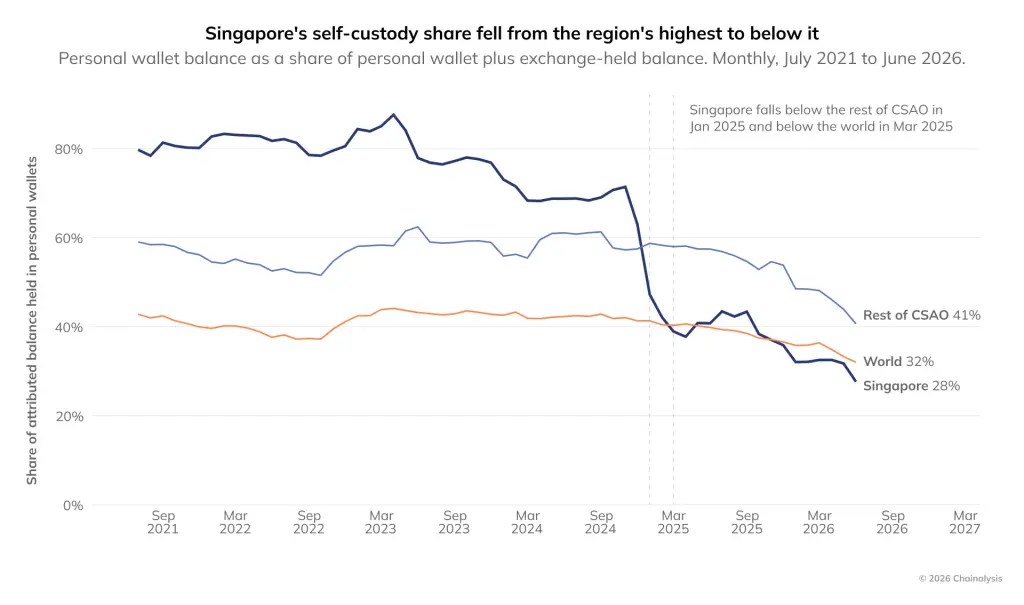
Shift in storage models: Users have become much less likely to hold assets in personal non-custodial wallets. While their share stood at 88% in 2023, it had fallen to 28% by mid-2026. Capital is flowing into the management of regulated custodians. This occurred because the Monetary Authority of Singapore (MAS) tightened standards and began actively restricting the operations of unlicensed platforms, such as Hyperliquid.
Top 3 Regions: Australia’s Success and India’s Challenges
The region’s leaders are showing completely different trends, which are directly linked to local legislation:
Singapore ($284 billion, 55.4% growth): The undisputed leader, where the bulk of liquidity is concentrated and the rules of the game are clear.
Australia ($173.1 billion, a 5.6% decline): Despite a slight decrease in total volumes, the inflow of institutional funds rose by 33.3% (to nearly $40 billion). This is all thanks to the launch of local spot crypto ETFs and the establishment of transparent rules for the stock market.
India ($135 billion, down 14.7%): India still leads in terms of deposit volume on centralized exchanges ($88.4 billion), but the local infrastructure is in a deplorable state. The share of Indian exchanges has fallen below 1% as investors are flocking to overseas platforms. The reason is simple: the government has imposed a steep 1% transaction tax that is stifling the market.
Stablecoins and P2P: The New Reality in Southeast Asia
While Singapore deals with large capital, in the region’s developing countries, digital dollars have become a tool for everyday tasks.
Explosive demand for remittances: Across Southeast Asia, the volume of cross-border remittances in stablecoins is, on average, 3.2 times higher than domestic remittances. In Malaysia, this gap has reached a record high of 30 times.
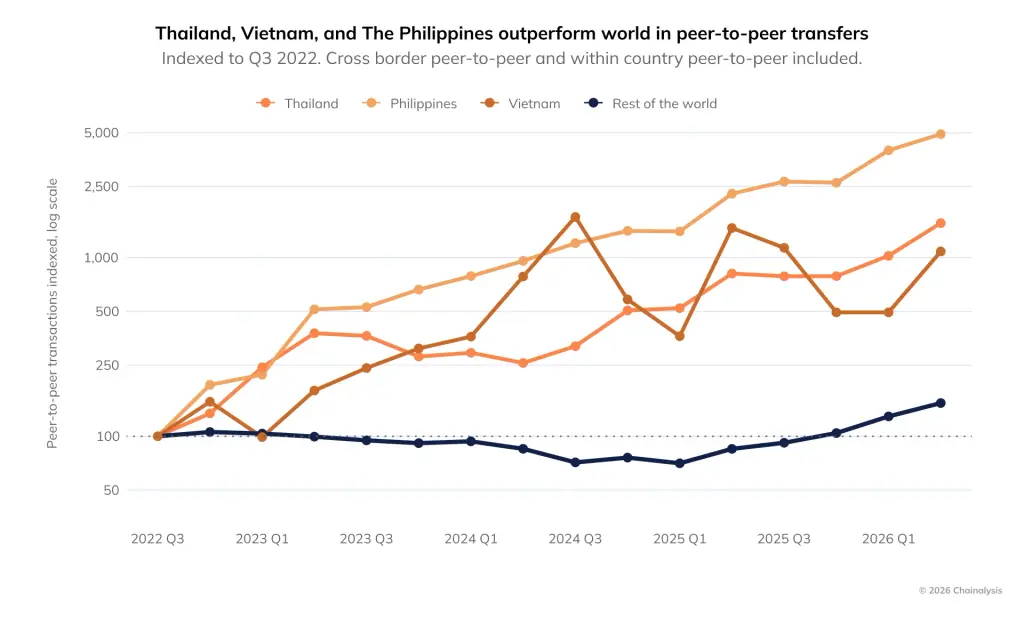
Replacing banking services: In the Philippines, stablecoins already account for 5% to 10% of all private remittances from migrant workers.
Micropayments: The Philippines, Thailand, and Vietnam account for 14.4% of the global volume of small P2P transactions (up to $10,000). The average transaction amount here is only $618, which is significantly lower than the global average of $1,210. This further demonstrates that cryptocurrency is becoming a common means of payment in these countries.