

Overall Market Situation
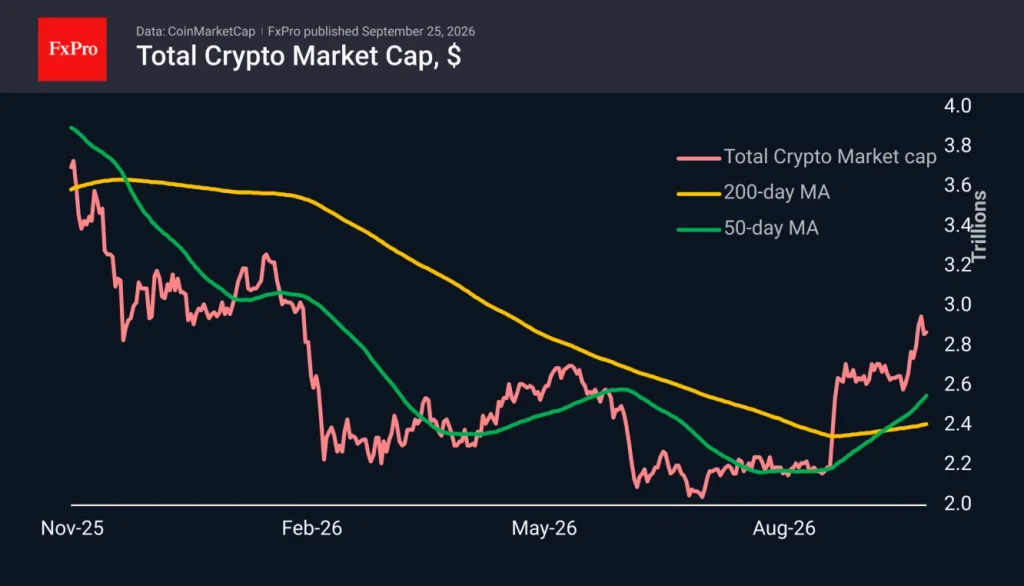
By the end of Thursday, the crypto market had fully recouped its 1.5% intraday decline and returned to Wednesday’s levels, with market capitalization hovering around $2.86 trillion. It appears that market participants are now trying to carefully consolidate at current levels, and the recent price decline was simply a localized profit-taking move following a sharp rally.
If we look at how people reacted to the news, a global shift toward buyers occurred back in August, although the rally from the bottom actually began in early July. Sharp corrections are normal during the early stages of a bull cycle. At the same time, the market is performing well: any pullbacks are immediately bought up, and positive news triggers a much stronger response than negative news. In essence, the industry is just beginning a major uptrend that could last for the next year or two.
Here’s what’s happened with altcoins over the past 24 hours:
Top gainers: Stellar (+8.4%), Chainlink (+8.2%), and Algorand (+7.8%).
In the red: Uniswap (-2.1%), The Graph (-1.5%), and Tron (-1.4%).
Bitcoin and Hidden Macro Risks
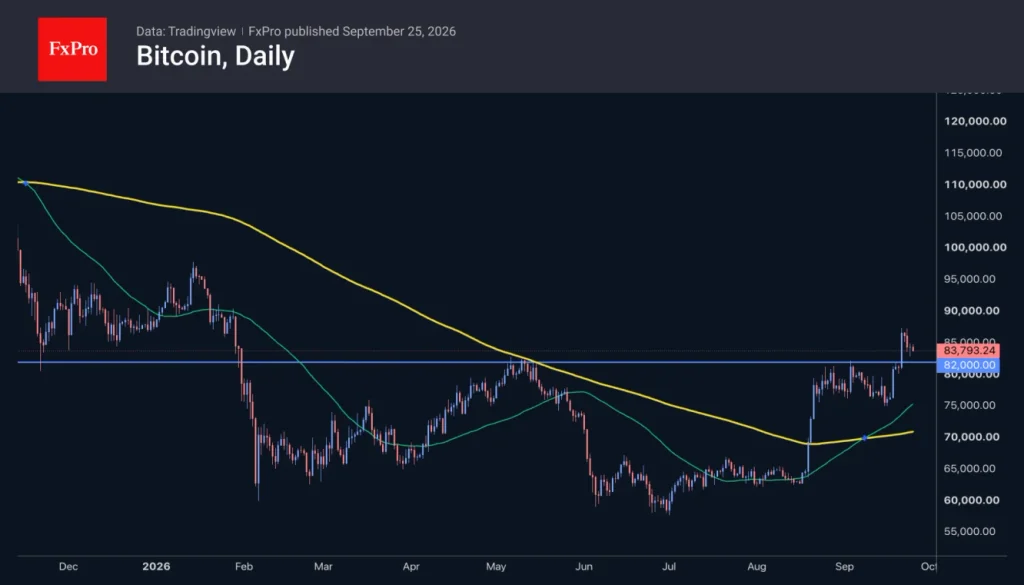
On Friday, at the opening of the European session, Bitcoin stabilized around $84,000. Yesterday, support at the $83,000 level helped halt the decline, but there are no new catalysts for a sharp rally yet.
The macroeconomic backdrop is somewhat concerning. The Nasdaq 100 Index appears to be holding near all-time highs, but its growth is driven primarily by a small group of tech giants. Furthermore, the rise in the dollar and U.S. Treasury yields suggests that liquidity is gradually flowing out of risky assets.
Possible scenarios for BTC:
Moderate correction: If pressure on risky assets persists, the price could retest the $82,000 level or even dip slightly below it.
A deep pullback to $75,000: If the price moves toward this level (which also marks the important 50-day moving average), it will likely cause panic among altcoin holders. But from a technical standpoint, even such a drop won’t break the uptrend and will remain within the framework of long-term growth.
Analytical Digest: Institutional Investors, Risks, and Tokenization
- Institutional Demand: Spot ETFs Back in the Black
According to Bloomberg, U.S. spot Bitcoin ETFs have fully offset all capital outflows since the beginning of the year. This trend was particularly strong last month, when net inflows totaled $4.6 billion. This turnaround coincided with news from the U.S. Treasury Department regarding the expansion of its government bond buyback program, which spurred interest in alternative ways to preserve capital.
At the same time, major players are acting with confidence. A Bitwise study showed that institutional investors not only held onto their positions during the bear market but also systematically increased them. The main obstacles for them now are complex compliance rules and the risk of volatility.
- Macroeconomics and Skepticism
Despite the influx of liquidity, experts are still warning of risks. Bloomberg strategist Mike McGlone is not convinced that the $60,000 mark represents the true bottom of the current cycle.
The main risk is fierce competition for capital from the stock market and U.S. bonds. Bond yields are hitting multi-month highs, which always makes risky assets less attractive in the short term.
- Record Options Expiration: A Key Moment
Where the price goes from here depends largely on how the massive derivatives expiration on Friday, September 25, plays out. This will be the biggest event of all of 2026:
The total volume of contracts will amount to approximately $18 billion across the entire crypto market.
For Bitcoin, this amounts to 184,000 contracts worth $15.9 billion.
The largest concentration of liquidity is centered around the $85,000 level.
The “Max Pain” level is around $75,000.
Although the Max Pain level is not a guaranteed target, how the market behaves after settlement will set the pace for the near term.
- Partnerships and Barriers to Adoption
Tokenization by BlackRock and Ondo Finance: Industry giant BlackRock, in partnership with Ondo Finance, has announced the launch of tokenized investment portfolios. The product is designed for investors outside the U.S. and will allow them to trade digital versions of traditional instruments 24/7.
Stablecoins and public trust: A survey by Visa and Morning Consult showed that currently about 36% of Americans are willing to use stablecoins. However, if banks provide deposit insurance and protection against fraud, that willingness will rise to 56%.